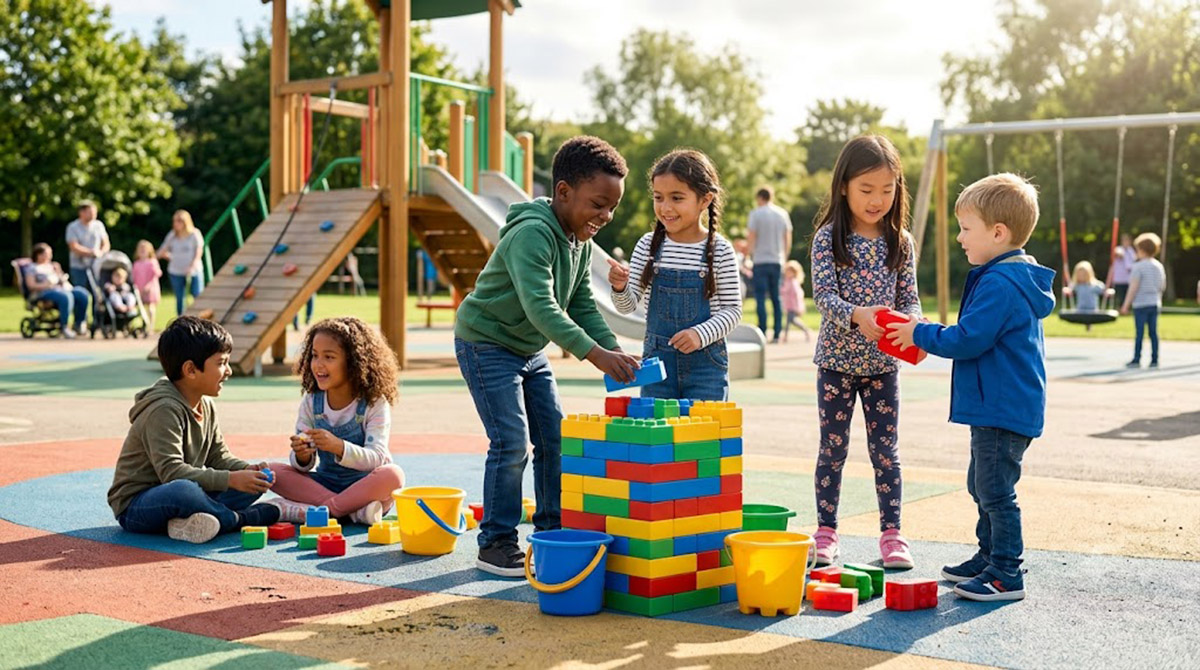
A pile of blocks on the floor can look like a mess to adults, but to children, it can be a training ground for friendship. One child asks for the red block. Another says no. Someone builds a tower, someone knocks it down, and there are feelings, choices, apologies, ideas, and laughter in the same small space. It gives children a natural way to practise the social skills they will use at home, in school, at parties, and eventually in the wider world.
Parents do not need a complicated programme to help children grow socially. Everyday play already gives children practice in talking, listening, waiting, leading, following, and making up after conflict. For families who want broader developmental guidance alongside practical parenting tips, it helps to see play as part of a child’s whole growth, not just a way to pass the afternoon.
Small Play Moments, Big Social Growth
Play teaches children how people work together. Through pretend games, turn-taking, chasing games, building projects, and quiet play beside others, children learn to read faces, use words, share space, solve problems, and recover when things do not go their way.
Play Is a Child’s First Social Classroom
Before children can explain what cooperation means, they feel it. They feel it when a friend helps carry toy food to a pretend picnic. They feel it when a sibling waits while they finish a puzzle. They feel it when an older cousin changes the rules of a game to let a younger child join in. These moments may look casual, but they are full of social learning.
During play, children meet real social situations in a low-pressure way. They can test a joke, copy a role, try being brave, or practise saying no. They can also fail safely. A child who grabs a toy may see another child cry or walk away. A child who refuses every idea may find the game stops being fun. These natural results help children understand that their actions affect others.
The Social Skills Children Practise Through Play
Social skills do not arrive all at once. They grow through hundreds of repeated moments. A playdate, a playground visit, a craft table, or a pretend shop can all teach children how to take part in a group. The skills below often appear during ordinary play.
- Communication: Children learn to ask for what they want, explain ideas, listen to others, and use body language. Even a simple game of pretend restaurant asks children to speak clearly, respond to requests, and stay involved in a shared story.
- Cooperation: Group play shows children that some goals need more than one person. Building a blanket fort, setting up train tracks, or creating a dance routine all require children to combine ideas and take shared ownership.
- Empathy: Children begin to notice when another child feels sad, excited, nervous, or proud. Pretend play is especially useful because it lets children step into another role and imagine what someone else might think or feel.
- Confidence: A child who suggests a game, leads a round, or solves a small problem learns that their ideas matter. Positive play experiences help children feel capable around others.
- Problem-solving: Play brings tiny problems all the time. There are not enough crayons. Two children want the same truck. The tower keeps falling. Children learn to pause, think, try another plan, and ask for help when needed.
Why Unstructured Play Matters
Planned activities are useful, but children also need open-ended time. Unstructured play allows them to create the rules instead of only following adult instructions. This matters because social life is rarely scripted. Children need practice reading the room, adjusting to others, and finding their place inside a shared activity.
In child-led play, children decide whether a cardboard box is a rocket, a shop, a boat, or a hiding place. They may change the story halfway through. They may disagree. They may restart. These flexible moments stretch social thinking because children must keep checking whether the group is still together emotionally, not just physically.
Parents can support this kind of play without taking over. A nearby adult can help with safety, name feelings, and step in when conflict becomes too hard. The goal is not to solve every disagreement instantly. The goal is to give children enough space to try, while still knowing an adult is there if they need help.
Group Play Builds Skills That Solo Play Cannot
Independent play is valuable, especially for creativity and focus. Group play adds another layer. It asks children to manage their own ideas while making room for someone else’s. That balance is at the heart of social development.
Children learn sharing, patience, and kind behaviour through repeated real-life practice. Gentle reminders can help, and familiar routines from sharing and kindness can make those lessons feel more natural during daily play.
How Different Types of Play Support Social Growth
| Type of Play | Social Skill Practised | Parent Support |
|---|---|---|
| Pretend play | Empathy, language, imagination | Add simple props and let children lead the story. |
| Building play | Cooperation, planning, patience | Ask what each child wants to build and how they can combine ideas. |
| Outdoor games | Turn-taking, self-control, confidence | Keep rules simple and adjust them for younger children. |
| Art and craft | Sharing materials, conversation, encouragement | Provide enough supplies, but allow some shared items for practice. |
Handling Conflict Without Spoiling the Fun
Conflict during play is not a sign that the activity has failed. It is often the moment when the most useful learning begins. Children argue because they are still learning how to want something strongly while respecting another person’s feelings. That is a hard skill, even for adults.
A parent’s response can turn conflict into learning. Instead of jumping straight to a punishment or a lecture, pause and describe what is happening. “You both want the blue car.” “Maya looks upset because the game changed.” “You are angry because your tower fell.” Naming the problem helps children slow down and understand the social picture.
Families preparing for friends to visit can also set expectations early. Simple ideas from conflict-free playdates can help children know what to do when toys, turns, or rules become tricky.
Practical Ways Parents Can Encourage Social Play
Children do not need perfect playrooms or expensive toys to build social skills. They need time, space, and adults who can guide without controlling every moment. The best support often looks simple from the outside.
- Start small: Invite one child over before planning a bigger group activity.
- Use simple materials: Blocks, scarves, cardboard boxes, crayons, and balls invite shared ideas.
- Prepare common phrases: Teach children to say “Can I have a turn?” or “Let’s try both ideas.”
- Praise social effort: Notice waiting, helping, inviting, apologising, and trying again.
- Allow quiet breaks: Some children need pauses during group play to reset.
It also helps to match expectations to age and temperament. A toddler may only manage short moments of playing near another child. A preschooler may still need help sharing a favourite toy. A school-age child may understand fairness but struggle when losing a game. The CDC notes that children reach milestones in how they play, learn, speak, act, and move, which makes developmental milestones a useful reference when parents are wondering what is typical at different ages.
Play Helps Shy Children Find Their Voice
Some children rush into every game. Others watch first. A quieter child may need time before joining, and that does not mean they are unfriendly. Watching is often part of learning. From the side of the play mat, a child can study the rules, the mood, and the personalities in the group.
What Parents Should Watch For
Every child develops at a different pace, but patterns matter. A child who sometimes struggles with sharing is not unusual. A child who avoids all interaction, rarely responds to others, or becomes distressed in most play situations may need extra support. Parents know their children best, and concerns are worth raising with a paediatrician, teacher, or child development professional.
It is also worth watching the play environment. Some children struggle socially because the activity is too noisy, the group is too large, the rules are too complex, or they are tired and hungry. Adjusting the setting can make a big difference. A calmer room, a shorter playdate, or a clearer routine may help a child show skills that were hidden by stress.
Where Little Friendships Begin
Play helps children build social skills because it turns big life lessons into small, repeatable moments. A child learns to wait while passing crayons. They learn empathy when a friend feels sad. They learn communication while planning a pretend shop. They learn confidence when their idea becomes part of the game.
Parents do not need to force every lesson. They can create chances, stay nearby, and help children reflect when things get difficult. Over time, those ordinary moments become something much bigger than play. They become the early roots of friendship, kindness, resilience, and belonging.